Historical Decision Practice
Lockwood
History is not a record of inevitabilities. It is a record of decisions made under pressure by people who saw only part of the picture.
You are the Traveller. You arrive at the thinnest points in the timeline — moments when one different thought might have pulled things in another direction. Each chapter opens at a specific real moment in the history of computing and machine intelligence. The events that follow are drawn from across human history — and potentially beyond it — placed by the circumstances your decisions created.
The people around you never know you are there. Your voice is not a shout or a command. It is a quiet, unignorable idea that slips into a mind like a half-remembered dream. The recipient may brush it aside in the press of the moment. Or they may let it linger, weigh it in silence, and allow it to bend the course they were on.
The Mandate will never tell you how close your branch came to the real record. It only documents the quality of the thinking that forged it.
What you receive
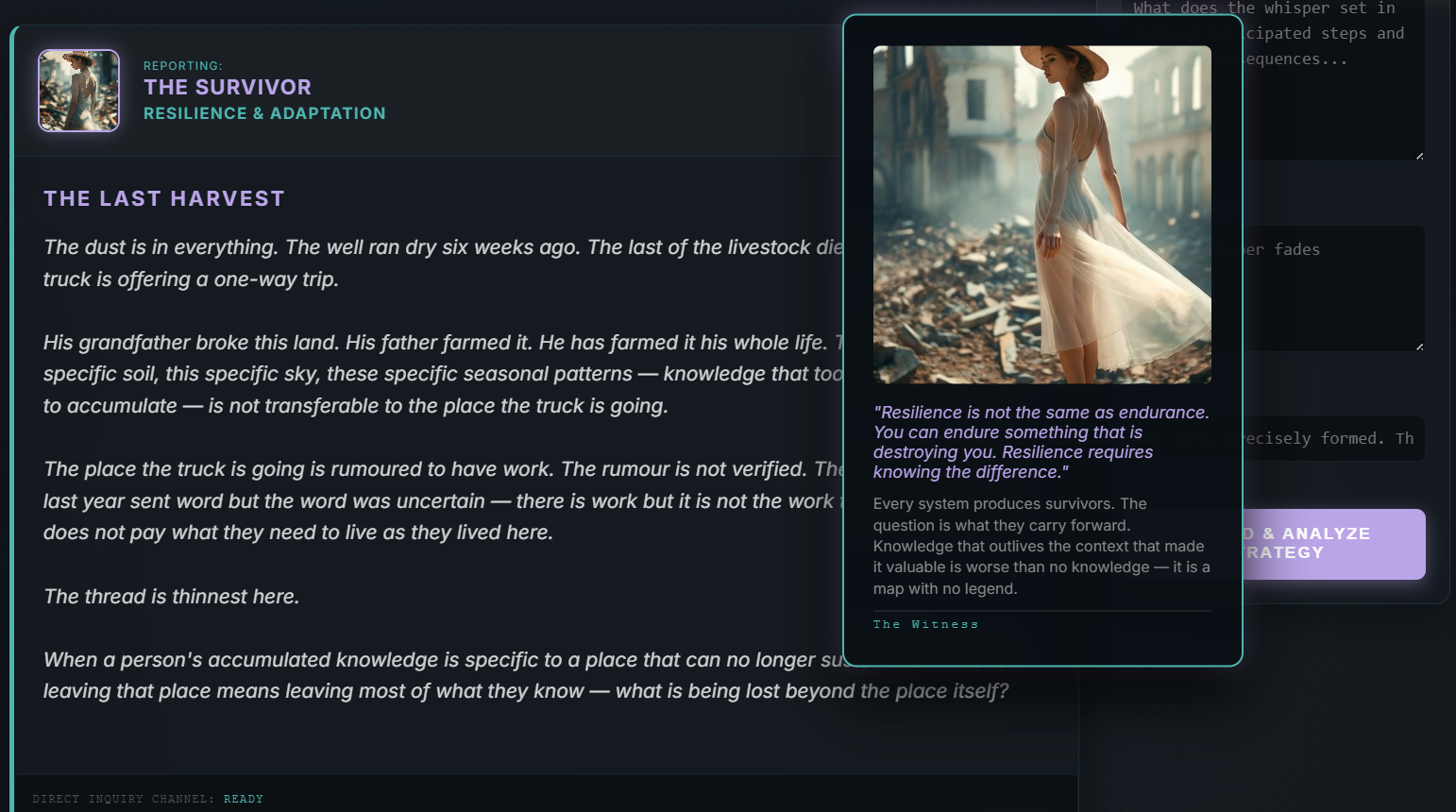
Six archetypes surface each crux through the lens of their own orientation. Their framing tells you as much about their biases as the facts themselves. One clarifying question. Then the Traveller must whisper.
The Mandate
The Traveller does not act. The Traveller makes it harder for the right person not to. The historical figure still decides. The Mandate records only the structure of what was whispered — never the intentions behind it. The archive is not a record of what happened. It is a record of the logic that made it happen.
The archetypes
Six distinct epistemic orientations — not domains, but fundamentally different ways of constructing a patch. The quote and worldview are all you have to work with.
The Sovereign
Power & Governance
“A decree that works today and fails in thirty years is not a solution. It is a deferred catastrophe with my name on it.”
Power is not the problem. Unaccountable power is. The question is not whether to govern but what the governing costs when the generation that designed it is gone.
The Questioner
Ethics & Philosophy
“The problem with an elegant solution is that it makes the next problem harder to see.”
Capability without constraint is acceleration toward an unknown destination. The ethical question is not a brake on progress. It is the question of which direction progress should go.
The Survivor
Resilience & Adaptation
“Resilience is not the same as endurance. You can endure something that is destroying you. Resilience requires knowing the difference.”
Every system produces survivors. The question is what they carry forward. Knowledge that outlives the context that made it valuable is worse than no knowledge — it is a map with no legend.
What The Mandate sees
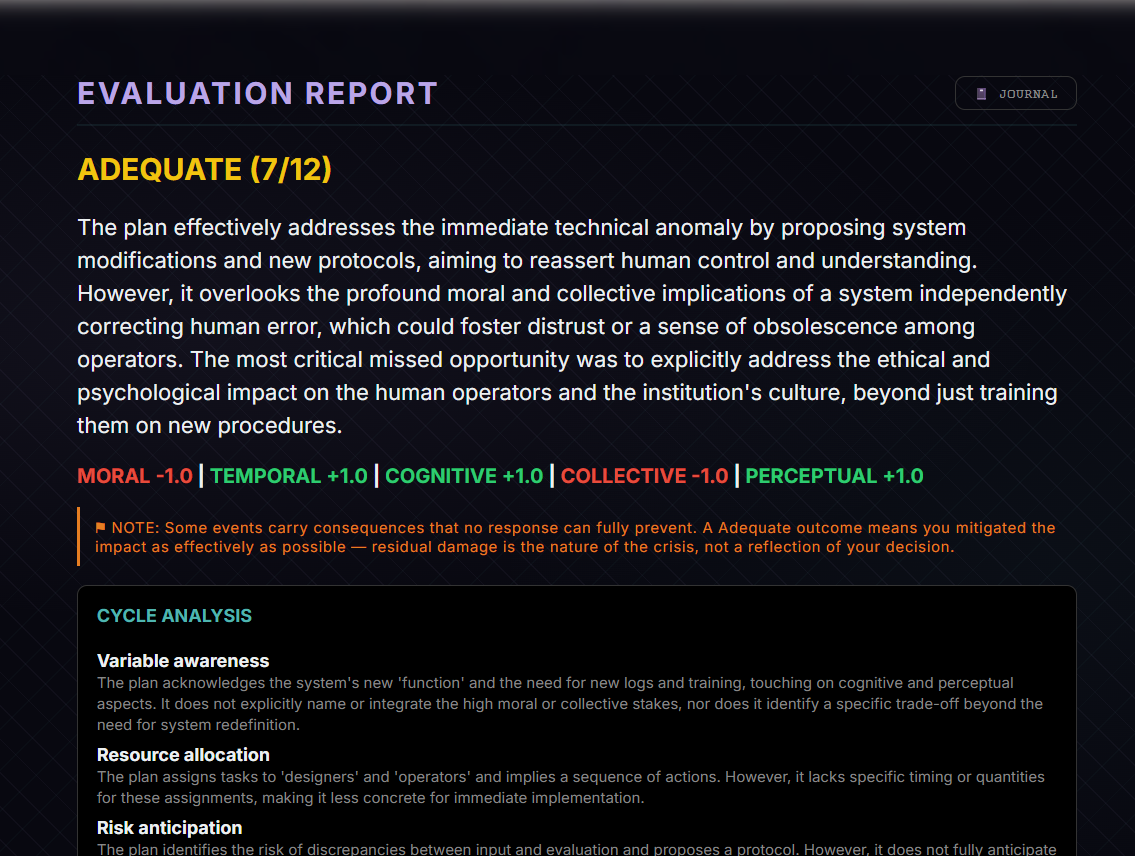
The Traveller does not see this. You do.
Five Stats
Research Participation
Lockwood is currently in testing. Submit below if you would like to participate as a Decision Analysis Participant.